
The Mobile Notary Advantage: What 24 Years in Long Beach Has Taught Me
- kmckendell
- Feb 20
- 6 min read
It was 5:47 pm on a Tuesday. A daughter called me from the hospital — her mother was being prepped for surgery in the morning and a power of attorney still needed to be signed. I was there within the hour.

That call is not unusual. In 24 years of mobile notarization across Long Beach and surrounding communities, I’ve handled signings at bedsides, kitchen tables, law offices, and everywhere in between.
What I’ve learned is this: when a document matters, where and how it gets signed matters just as much.
Documents requiring notarization tend to surface at pivotal moments — property transfers, estate planning, healthcare directives, financial authorizations. The act of notarizing may take minutes. The process surrounding it rarely does.
If you’re deciding between a mobile notary and driving to a notary office, this guide gives you a straight answer. No fluff. Just what actually makes a difference depending on your situation.
What A Mobile Notary in Long Beach Actually Does
A mobile notary is a fully commissioned California notary public. Same credential, same legal authority, same result. The only difference is that I come to you.
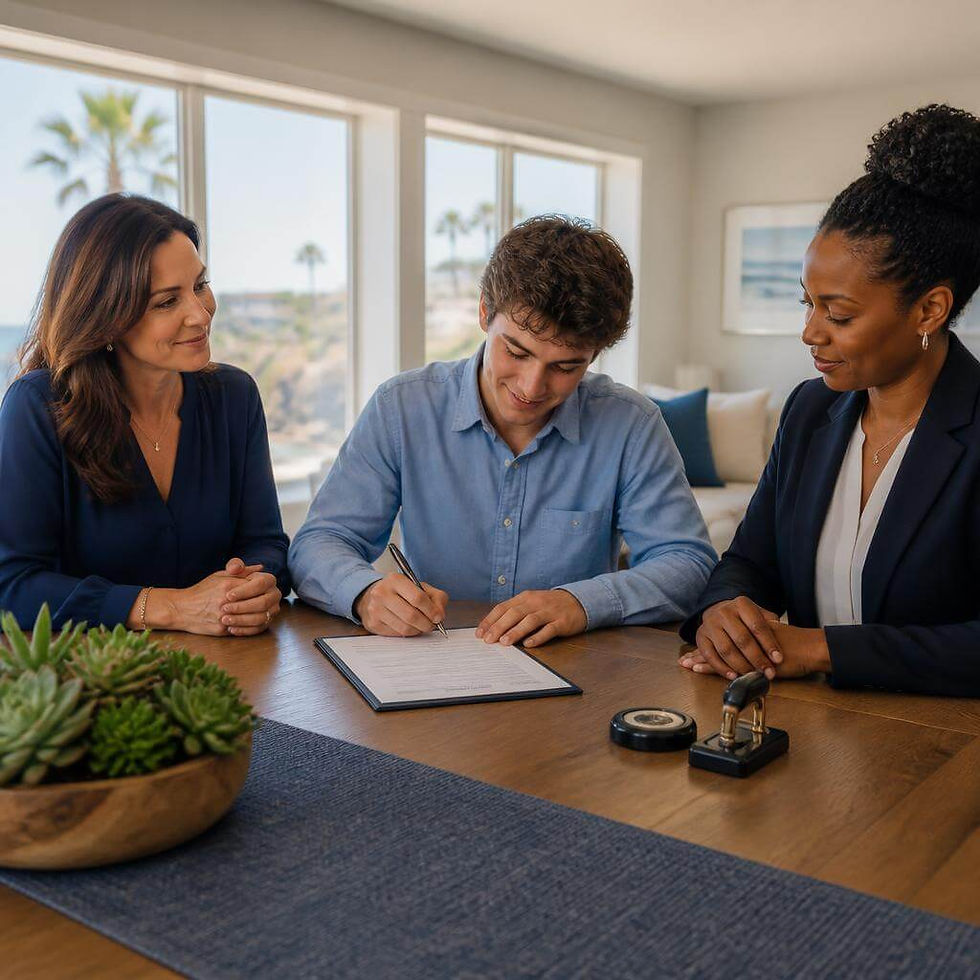
Your home. Your office. A hospital room. An assisted living facility. A real estate closing. A conference room at 7am before your workday starts. Wherever the document needs to be signed, that’s where I show up.
What you’re gaining is control over your time, your setting, and your experience.
The Real Cost of Visiting a Notary Office
On paper, walking into a notary office looks straightforward. In practice, it rarely is.
Time away from work. Traffic. Parking. A wait because someone ahead of you has a complicated situation. What was supposed to take twenty minutes becomes ninety — and that’s before you factor in the drive back.
Even locations that advertise walk-in availability can’t guarantee a wait-free experience. Retail counters and bank branches operate with shifting customer volume. A single complex transaction — loan paperwork, affidavits, certified copies — can significantly extend the visit for everyone behind it.
For professionals, that unpredictability means time away from work. For families coordinating multiple schedules, it’s a logistics problem. For clients with mobility challenges, transportation becomes the central obstacle rather than the notarization itself.
.The notarization fee at an office might look lower upfront. But when you add your time, your travel, and the disruption to your day, the math often flips.
Mobile Notary vs. Notary Office: Side by Side
Factor | Mobile Notary | Notary Office |
|---|---|---|
Who travels? | No one — I come to you | You do |
Wait time | Zero — scheduled just for you | Unpredictable |
Setting | Your home, office, or care facility | Busy retail counter or office lobby |
After-hours & weekends | Available | Rarely |
Hospital / care home | Yes — bedside if needed | Not possible |
Complex documents | Unhurried, private, properly sequenced | Rushed, public environment |
Apostille coordination | Handled together in one appointment | Requires separate trips |
Cost transparency | All-in fee, no surprises | Base fee + your time + travel |
When the Setting Matters as Much as the Signature
Not everything that gets notarized is routine paperwork. Advance healthcare directives. Trust certifications. Powers of attorney. Corporate resolutions. Financial agreements tied to a major life transition.
These aren’t documents people want to sign at a busy counter with strangers nearby. Noise, interruptions, and time pressure can subtly increase the likelihood of oversight — and rushed decision-making on documents with real legal consequences.
Mobile notarization allows signings to occur in familiar surroundings, with fewer distractions and without external pressure. Clients are able to review documents at a comfortable pace rather than navigating interruptions, noise, or perceived urgency.
That’s one of the things I hear most from clients afterward — how much it meant to handle something important in a familiar place, with enough time to actually read what they were signing. No one rushing them. No one within earshot.
For estate planning signings especially, the environment isn’t a minor detail. It’s the difference between a signing that’s done right and one that has to be done again.
Complex Documents Benefit from Structure
Multi-document packages are where errors happen. Estate plans. Business agreements. Loan signing packages. These aren’t single-page forms — they’re often twenty, forty, sometimes over one hundred pages that need to be executed in a specific sequence.
Get the order wrong or miss an initial, and you’re looking at delays, re-signings, and in some cases a closing that falls through entirely. I’ve seen it happen at offices where the notary was managing three clients at once.
On a mobile appointment, my attention is on one signing. Your documents. Your timeline. Every page gets checked before I leave, so nothing gets flagged after the fact.
Experience, preparation, and pacing matter most when documents carry legal or financial consequences. Precision at the moment of execution prevents complications later.
When Mobile Isn’t a Convenience — It’s the Only Option
For some clients, visiting a notary office isn’t just inconvenient. It’s not possible. These are the situations I step in for most often:
• Hospital and bedside signings
• Assisted living facilities
• Clients with mobility limitations or health conditions that make travel difficult
• Urgent same-day needs that can’t wait for an available office appointment
• Real estate closings and loan signing appointments that must happen on-site or on a
deadline
• Professionals and families whose schedules don’t allow for a mid-day trip across town
What may initially appear to be a convenience often turns out to be what makes the signing possible at all.
A Real World Perspective
A son is coordinating his father’s estate plan signing. His father has limited mobility and can’t easily travel. His sister is flying in from out of state and has a tight window before her return flight. The document package is substantial — a trust, a will, powers of attorney, an advance directive.
Visiting a notary office with all of this in motion — two signers, one of whom can’t travel easily, and a stack of unfamiliar documents — would have been its own project. |
Instead, I came to the house. We went through each document at a pace that let everyone actually understand what they were signing. His father didn’t have to navigate a parking lot or sit in a lobby. His sister caught her flight. Nothing had to be redone.
That’s not a special case. That’s what a well-run mobile signing looks like.
Apostille Services in Long Beach
If your document is headed overseas, you may need more than a notarization. An apostille is a certification that allows documents to be recognized in foreign countries under the Hague Convention.
You might need a California apostille for an international business transaction, a foreign adoption, an overseas education credential, or legal proceedings abroad. It’s a separate step from notarization — but one I can coordinate for you, often without requiring a separate trip anywhere.
Many clients are unaware that notarization and apostille facilitation can often be managed together, reducing confusion, administrative delays, and unnecessary travel. Clarifying that is part of what I do.
Apostille services are available throughout Long Beach, Lakewood, Signal Hill, Seal Beach, Torrance, Carson, Bellflower, and surrounding LA and Orange County communities.
Frequently Asked Questions
How much does a mobile notary cost in Long Beach?
Mobile notarization fees reflect travel, scheduling flexibility, and a private appointment. Quotes vary based on document type and location.
Can a notary travel to hospitals or care facilities?
Yes. Hospital bedside signings and assisted living appointments are among the most common mobile requests.
What is a California apostille?
An apostille certifies a document for recognition in Hague Convention countries. Requirements vary by destination.
Can complex document packages be handled by a mobile notary?
Yes. Mobile notarization is frequently preferred for estate planning documents, property records, and multi-document signings.
Who typically uses mobile notary services?
Families, attorneys, business owners, real estate professionals, elderly clients, and individuals facing scheduling or mobility constraints commonly rely on mobile notarization.
Notarization is often viewed as a simple administrative step, yet the documents involved rarely feel routine to the people signing them. Many appointments arise during moments of urgency, transition, or significant financial and personal decisions. In those situations, the value of mobile notarization becomes unmistakable. It removes logistical friction, preserves privacy, and allows documents to be executed with the care and attention they deserve.
Rather than adapting your schedule, comfort, or circumstances to a notary office, the signing unfolds on your terms — unhurried, precise, and conducted in an environment appropriate to the importance of the moment. The result is not merely convenience, but a smoother, more controlled experience from beginning to end.
When timing, accuracy, and setting matter, mobile notarization removes unnecessary obstacles. Appointments are available at your home, office, hospital, or care facility. For availability, including same-day and after-hours service, call or text (562) 477-3166.
ABOUT THE AUTHOR
Kimberly McKendell is the owner of Notary Long Beach – Mobile Notary & Apostille, providing mobile notarization and apostille services throughout Long Beach and surrounding communities for more than 24 years.
She works with families, local businesses, attorneys, real estate professionals, and clients that require precision, discretion, and reliability in document execution. With extensive experience handling trust certifications, apostilles, estate planning documents, business agreements, real estate closings, and time-sensitive notarizations, Kimberly is focused on one thing: a signing experience that is unhurried, private, and done right the first time.


Comments